MY WORK
by Robert W. Parsons
DrieBiene
Aus den Augen, aus dem Sinn.
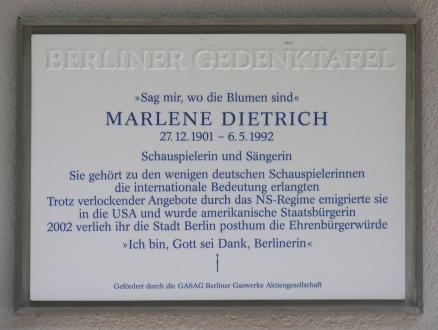
BERLINER GEDENKTAFEL
>>Sag mir, wo die Blumen sind<<
MARLENE DIETRICH
27.12.1901 – 6.5.1992
Schauspielerin und Sangerin
Sie gehort zu den wenigen deutschen Schauspielerinnen
Die internatinonale Bedeutung erlangten
Trotz verlockender Angebote durch das NS-Regime emigrierte sie
In die USA und wurde amerikanische Staatsburgerin
2002mverlieh ihr die Stadt Berlin posthum die Ehrenburgerwurde
>>Ich bin, Gott sei Dank, Berlinerin<<
Gefordert durch die GASAG Berliner Gaswerke Akteingesellschaft
I didn’t need a light to see in the dark cave. I’m a vampire of light. Some would compare me to a bat who can see in the dark. Actually, bats navigate in the dark by radar, not sight. So, vampires and bats have nothing in common.
Some of you might have paid attention and caught the different spelling of the number three in German. Drei is the Pennsylvania German of the United States. Drie is the middle German or dri the old high German of the country of Germany. Just a simple language lesson here to distinguish the difference in spelling.
If you wear night vision goggles, you can picture what I mean by seeing in the dark. This cave I found was in a rocky, mountainous central region near the Black Forest in Germany. This is where God had led me to after leaving Gabe.
With eternity on my hands, I travel the world and go places the normal traveler cannot get to without special transportation and/or equipment. So, I was climbing this rock face without climbing gear and discovered this cave behind a rockslide that must have fallen from natural erosion.
Moving the large rocks was no problem for me. For others, it would have been blasted away for no machinery or aircraft could have separated this one massive boulder from its resting place.
It was cool inside the cave, but not damp, even with the snow piled on the ledge that blew in through the small opening between the boulder and cave. The cold neither bothers me so a normal man would have been dressed in layers covered with a large parka and goggles to keep the blinding snow and wind that would whip up a chill to the bone.
In cold temperatures, I have no breath that could be seen when one exhales. To me, it was just another normal day of adventure in which I stumbled onto this cave, on a cliff face, high in the frigid, snowcapped mountains near the Black Forest in Germany. It was January 2007.
I was hoping to discover some long-lost treasure in this remote mountain cavern and wondering at the same time why God sent me to this country. Instead of dwelling on why, I looked around and found only a photograph which seemed to be in good condition. I found
nothing else. So how did this black-and-white photo, with a yellowish hue, end up in this cave and well preserved?
Without a light, I could still make out who and what was in the picture. The picture showed a lady dressed in old clothes - I’m guessing 1940s, maybe earlier. She had no jewelry except a large bullet on a chain around her neck. My thought was that it was an unusual piece of jewelry for such a sophisticated lady.
She was sitting at a table with a capped bottle of beer next to her. Behind her, I could make out a bar with many bottles on the wall and a sign that read DreiBiene. Sitting next to the lady was a gentleman with - what we call today - a campaign button. This picture must have been taken in the 1940s because on the button was a picture of Adolph Hitler. It was probably a propaganda button.
Disappointed in my find, I rolled the picture up and placed it in my pocket of my duster coat. I descended the mountain and traveled by foot through the valley until I came upon a small, quaint village. The village looked like it had been lost in time. Only a few buildings had electric lights, which I assumed ran off of generators. The other lights along the streets must have been oil lanterns. A gentleman was lighting the lights with a fire stick, for it was dusk.
The gentleman greeted me in German, “Guten Tag.” I replied with a good evening as I nodded.
What caught my attention was a flashing neon sign. It was flashing like it was about to burn out, running on a generator that was sharing what electricity it generated. The sign read, between synaptic flashes, DreiBiene.
Oh my god was my first thought. This name, whatever it meant, was in that picture I found in the cave. I went in. The few people, mostly men, all turned to see who had entered. Nothing was said as I made my way to the bar.
And there was the sign as it was in the picture. The bartender spoke German. I assumed he was asking me what I wanted to drink, so I just asked for a beer.
“Ah, an American,” the bartender said in broken English.
“A Native American,” I responded as he poured me a beer from the tap. I thanked him as I paid for the beer, turned around, and sat at the table I assumed was the table that was in the picture. As I sat, I turned around to see if the sign was in line to where I was sitting. It was, just like in the picture.
I had just taken a sip of my beer when a very old gentleman, with a walking cane, came over to my table and welcomed me to the DreiBiene. His still chiseled, thin but withered face, drew me to his eyes. I could read a person through their eyes. His eyes told me in one word - loneliness.
In broken English, he said, “My name is Marlen Dietrich. I’m the owner of this fine establishment.” And yes, I had a questioning look on my face.
“Marlen Dietrich?” I began to question. “Didn’t you forget an e on the end of your first name?”
Marlen smiled.
“Lola was my stage name and Marlene Dietrich was my idol. When I left the stage, I dropped the e. Marlen sounded more masculine in those hard times.”
“So, you were a Marlene Dietrich impersonator?” I questioned.
“Yes, she was my drag persona.” Without any questions from me, Marlen continued. “I was born in Berlin in 1915. I was not your typical boy. When Marlene’s movie, The Blue Angel, came out in 1930, I fell in love with Lola Lola, the character she played in the movie. I wanted to be just like her.”
Marlen was fifteen years old at that time. It’s 2007, so that would make Marlen ninety-two years old. For an old man, he was alert and mobile. “Tell me more,” I requested as I sipped on my beer.
“By the time I was twenty, I was working in a famous nightclub in Berlin. You’d be surprised how many of Hitler’s men would come in to see a drag show. I was waiting tables as I perfected Marlene. I was known in the bar as Lola, a soon-to-be stage performer.
“I had legally changed my name to Marlen Dietrich. I don’t think Adolph Schultz would have made a good stage name, especially when Hitler began to rise to power.
“I had just begun to perform and soon became a star overnight. The reviews said I was Marlene’s twin sister and sounded just like her. I had begun my impersonation practice at fifteen. So when I took the stage in my early twenties, I had perfected her sound using my own voice. My gowns were beyond imagination as they sparkled in the stage lights.”
I saw a light ignite in the old man’s eyes as he told me his story. An occasional tear escaped from those lonely eyes. He continued as I still wondered why he was telling me his story. Maybe he liked sharing his story. I was the perfect audience, a stranger.
“My act drew more people into the club. The club wasn’t a gay bar as the young people of today call it. It was more of a cabaret. I was the marquee, a live-show performer just like Marlene was before she went to Hollywood.”
I pictured the movie The Birdcage with Robin Williams.
“One night after a performance, I was requested by a patron to join him at his table. Much to my surprise, it was Adolph Hitler who had made that request. I sat to his right, with many of his guests which included my mother and father.
“Enough about me. What brings a handsome young man into my establishment, far away from the modern world? And an American to say the least.”
“By pure luck,” I responded. “I’m a lone traveler and just stumbled on this tavern when I saw the flashing neon sign, DreiBiene. First, what does that mean, and second, a neon sign in the countryside?” I questioned.
The old man laughed. “Just a bit of marquee to remind me of the good old days in Berlin when the bright lights adored me. Now that old light is like me, old and fading. Soon it will burn out as will I. And DreiBiene, it simply means ‘3B.’” He then pointed to the carving in the table top I had seen earlier but didn’t mean a thing to me. Now it did, sort of.
I pulled out the picture I had found in the cave and showed it to the old man. His eyes of loneliness then sparkled, changing to surprise. Or was it amazement or shock?
“Where did you get this?” he asked with some trepidation as his feeble old hands began to shake with a nervous agitation.
“I found it in a cave high in the mountains near the Black Forest.”
“When?” was all he said as he studied the picture.
“This morning.”
The old man stared at me then began. “So the rumors might be true,” And I asked for an explanation. “I took this picture back in 1943, or was it 1944? Well, anyway, it was at the height of the war.
“That night when I met Hitler, he asked, mostly demanded, I do a show at his retreat in the mountains. This establishment was a stopover on our way to his fortress. I only bought this place after I retired from the stage. The couple you see in the picture stayed in 3B while I stayed in 3C. 3A was occupied.”
“Why is this tavern called DreiBiene, 3B?” I continued to question.
“I think it was a code name of some kind. Maybe this establishment was part of Hitler’s underground, a secret meeting place. And the carving on the table and the room, it has to be some sort of secret code. At the time, I thought nothing of it. I was just an entertainer. Now with the rumors after the war, it makes some sense. But what?”
“Who knows?” I responded. “The 3B tavern, 3B carving, and 3B room. There is that number 3 again. Three items. Again, what does it mean? There has got to be some clues somewhere to solve this mystery.”
“Do you have a place to stay the night?” the old man asked.
“No” was my response, then I added, “Is 3B available?”
“All the rooms are available. Not too many guests stay here anymore. We’re not actually on the tourist route,” the old man said as he went to get the key to 3B.
I looked at the picture again and saw the man and women sitting at a table with DreiBiene in the background. The three B’s, three items. I studied the picture.
There it is! It was what I saw earlier in the picture while I was in the cave. Now it made sense. The three Bs, or 3B. The beer, the bullet and the button. The beer bottle was capped. The bullet was a necklace, an unusual type of jewelry to wear during a war. And the button, it had a picture of Hitler. So in my assumption, Hitler had something to do with the beer and bullet and the couple in the picture.
I retired to my room, 3B, for the night. I don’t sleep, so I lay on the bed, thinking. I looked around the room with the dim light of the oil lamp. The room was plain - a bed, a desk, a chair. The shared communal bathroom was down the hall.
I assumed the room had been searched. There was really nothing to look for. I turned the bed upside down and looked between the mattress and sheets. Nothing. I searched the desk, pulled the drawers out, turned them upside down, and checked for secret compartments. Nothing. Even the single picture hanging on the wall had nothing when I took it apart. The picture left a clear, dirty outline on the wall where it had hung for decades. The window didn’t budge as I saw snow beginning to fall outside.
I used my sensitive smell but only smelled mold and decades of dust and stale beer. I listened but only heard the distant squeak of a mouse somewhere in the tavern walls. I also heard a thud. I looked around the room using my eyes to look into the walls. And there it was, some-
thing between the walls, something that had been hidden for decades.
With no tools but my knife I kept in my boot, I cut a hole in the wall and withdrew its hidden content. It was a small book, a journal. This journal reminded me of the journals I use to hide in the walls of the barn before Matt discovered them after my death. And the journal of my great-grandfather was found within a cave along with all that gold. This all sounded too familiar.
The writing was in German. The only thing I could recognized was the two names, Ava and Hendrick Schultz. I literally flew downstairs to ask Marlen if these were his parents. The dim buzz of the single florescent light flickered as I found the old man slumped over a table.
I checked his pulse. I didn’t need to; it was just an impulse to do so. I couldn’t hear his heartbeat. I then noticed the flickering marquee, DreiBiene, wasn’t flickering anymore. It, too, had died. Now I was alone with a mystery in my hands.
I grabbed a pint of beer and sat with the old man the rest of the night, trying to remember his story of stage performances, his impersonation of Marlene Dietrich, and meeting Hitler. Were Ava and Hendrick Adolph Schultz’s parents? And what did Aus den Augen, aus dem Sinn mean?
And what about the journal? How did it end up in a wall in room 3B and in the tavern, DreiBiene, 3B? And the carving? The three B items - the beer, the bullet and the Hitler button? And the person who might have known the answers is now dead. Fortunately, he died of old age and not some mystery death like in the game of Clue. I already had too much mystery on my hands. My game of Clue had now begun.
I waited till someone arrived to care for the old man. I left with the picture and journal tucked safely in my pocket. I asked if I could have the burned-out marquee sign. Yes was the answer.
I went to Berlin to begin my search. I had the names of Ava and Hendrick Schultz along with Adolph Schultz, aka Marlen Dietrich, aka Lola.
I never found the marriage certificate of Ava and Hendrick, who said they were married in 1912. With further searching I found that this couple had two children, a boy and a girl. The boy’s name was Adolph, born in 1915, and the girl’s name was Gertrude, born in 1918. The nickname Gerty was written in parenthesis.
So Marlen was the son of Ava and Hendrick born out of wedlock? That would make sense since they were traveling together and henceforth the picture. With that mystery somewhat solved, it was onto Marlen’s sister, Gerty.
In 1939, just as Hitler was gaining more power, I’m going to assume that Girty began to see her parent’s involvement with Hitler and wanted no part of that.
I had found one other name in that journal with a date of 1939. The name was Jon Henry. I could not make out his last name. I’m guessing the name could have been either Italian or French. Since there was no last name to confirm my suspicions, I was at another dead end.
I had three choices. I first started with the marriage certificates in Berlin with the names of Jon Henry and assuming Gertrude was his wife. The year searched was 1939. Nothing. I then went to Paris and tried the same search. Nothing. Then it was off to Rome. Nothing.
I got a bit discouraged, so I took in the sights of Rome. I ventured to Florence then to Venice. Italy was home to my ancestors so that is why I roamed throughout Italy. At each venture, I came up with nothing until one day, in a small park in Napoli. Napoli is on the west coast of Italy across the waters from Sicily.
I sat next to an older gentleman who was reading a book. I asked if it was a good read. He smiled and replied yes in Italian. Fortunately, I understood Italian since I learned some Italian from my dad, whose father was from the Aosta Valley region of northern Italy.
I asked the title of the book and the author. This was the old man’s reply. “Flight to America by Jon Henry Giordano.” I asked to see the book. It was published in New York City in 1946. I read the back cover about the author. He was born in Napoli, married his sweetheart Gerty, and fled the soon-to-be war in Europe in 1939.
I dug in my pocket and pulled out a wad of money and offered it to the old man for the book. He counted out $752. The book was mine, and I was on my way to New York City.
My first stop was the publishing company in New York City which is still in existence. I met with the president, handed him the book, showed him the picture, and told him the story of how I would like to find Gerty, if still alive, or a child, the grandchild of Ava and Hendrick. He knew nothing. But he knew someone.
The son of the editor, the editor who worked with Jon Henry, was about ready to retire from the publishing company. Eric was his name. He said he was born in 1946, the same year Flight to America was published.
Eric remembered as a child dinner parties, book signings, and interviews he had to sit through since his mother died while giving birth to him. Eric’s dad took him everywhere with him. So Eric remembered those times with his dad.
Eric did remember a ten-year wedding anniversary he attended at age seven in 1953. He couldn’t remember the names of the couple, but he said he still had the invitation his dad saved in his book of memories.
Leafing through the book he found the invitation to the tenth wedding anniversary of Jon Henry Giordano and Gerty Schultz in Greenwich, Connecticut. I now had a clue. Greenwich, Connecticut, here I come.
And sure enough, I found a marriage certificate between Jon Henry and Gerty in 1943 taking place in Greenwich. The back cover of that book never said when or where they were married. I just assumed the marriage took place in Italy. Unfortunately, Gerty died in 2005 at the age of eighty-seven. Jon Henry had passed much earlier. I had just missed her by a couple of years.
Next stop was the hospital to check birth records. Luck was on my side. Gerty had twin daughters in 1948; Geltrude, which was the Italian form of the German Gertrude, and Gabriella, a feminine form of the Italian Gabriele, for Gerty was hoping for a boy I was soon to learn. Now I have something in common with Geltrude and Gabriella, for I, too, am a twin.
I checked the marriage records and found that both girls had married. I also found that both their husbands had been deceased for a few years. So when I checked the local directory, I found the address the same for both Geltrude and Gabriella. Both would be in their early seventies.
I called and told them my story in brief, in which they invited me over for tea. I accepted.
After some small chat and introductions, I showed the twins the picture of their grandparents I had found in a cave high in the mountains near the Black Forest of Germany several months earlier. I told them I stumbled upon a tavern where I met their uncle who passed that evening at the age of ninety-two.
Looking at each other they mentioned, “That must have been Uncle Lola.” The twins knew their family history and how their Uncle Adolph, aka Marlen Dietrich, aka Lola was known by. They said they had never seen that particular picture before.
I showed the twins the journal I found in the wall of room 3B at the tavern. “I only had the names of Ava and Hendrick Schultz, in which I discovered that Lola was their son. Then I found Gertrude, your mother, but lost the trail until I discovered the book your father wrote.
“That book brought me to New York and the tenth wedding anniversary of your parents which brought me to Greenwich which brought me here today.”
“So why are you actually here?” the twins questioned as I tried explaining the three B’s.
“I was hoping you could tell me why the importance of the three B’s,” I responded with bated breath.
Looking at each other, the twins turned back to me. “We have no clue,” Geltrude said as both shook their heads.
“But we do have a jewelry box Mom left us,” Gabriella began. “We haven’t opened it because it is locked and we don’t have a key.” My heart still skipped a beat as a human heart would have.
The twins gave me permission to jimmy open the jewelry box. It didn’t take much for me to open the old box. Inside was a beer bottle cap, a bullet on a gold chain, and a Hitler propaganda button. The three B’s actually were laid before me and not as some old relics in a picture of mystery.
I examined each one. There wasn’t anything peculiar about any of the items except for the inscription on the back of the button. I asked the twins if they could translate the inscription. They did. The words translated to “Out of sight, out of mind”. I asked if I could take them to a crime lab to be examined.
The results astounded me but confused the lab tech. I had compelled the lab tech to do the work and keep the results a secret. I also compelled him to forget the results and me once I had left the lab.
The results were numbers and letters, which could be of many combinations. Each piece had some numbers and letters. I assumed that all three needed to be together for the entire answer. Then I remembered the picture and the order of the three B’s. First, the bottle cap, then the bullet, and lastly, the button.
Beneath the cap were etched some numbers and letters. Encapsulated within the bullet were more of the same, but different. And on the lapel of Hitler’s uniform on the button were even more microscopic letters and numbers. So, putting these items in order with their respective letters and numbers gave me coordinates of longitude and latitude.
With the help of the computer, I got the location; the location was near the Black Forest of Germany. To be specific, the mountainous region where I had discovered the cave.
I handed the journal to the lab tech, and as he put his hand over his mouth. I asked what was wrong. He informed me that he was a World War II buff and the journal I had was a list of stolen treasures by Hitler that were thought to be lost or destroyed in the war.
The three B’s were code as to their location.
As I left the lab, I turned to see the lab technician scratch his head as though he were lost, then checked his watch. He shrugged his shoulders and went back to work. The secret of Hitler’s stolen treasures was still a secret, known only to me.
I returned to the twins, Gabriella and Geltrude. I told them the results, and they were both intrigued and surprised that their grandparents had such close contact with Hitler. In fact, I presume, they were part of or in charge of the heist of all those stolen artifacts. They had the exact location of the treasures on their person and in their possession all this time.
I returned to the cave I had discovered a few months earlier. Nothing had changed, of course, except there was less snow. It was then that I noticed the cave had a cave within, for rocks were piled everywhere. My first thought? I hope the treasure had survived if, in fact, this is the exact location of the longitude and latitude.
I had no inkling of treasure; therefore, the pile of rocks within the cave had no meaning at that time I first discovered the cave. I began clearing the rocks, tossing large boulders only a bulldozer could move. Again, moving the large boulders was no effort for me. Within minutes, an entrance was made without sweat. Remember, vampires don’t sweat.
With my night vision alerted, I stepped into a large room filled to the ceiling with artifacts. There was gold and silver, paintings, sculptures, and piles of money from different
countries. I couldn’t even begin to estimate the value. It had to be in the billions, maybe even trillions of dollars.
I found a large book that listed everything within the cave. Great care was given to inventory each item. I recognized the handwriting from a letter I read that the twins let me read. The letter was from their grandmother to their grandfather. The handwriting in the book was that of Ava’s but was signed Paula.
Upon further research, I found Paula to be Hitler’s younger sister and full blood sibling. So the question was, Was Ava actually Paula Hitler, working alongside her brother? According to the history records, Paula Hitler never married and died in 1960 at the age of sixty-four.
Did Ava and Hendrick ever marry? Did Marlen ever know his mother might have been Hitler’s sister and Hitler was actually his uncle? Records from that time period were either lost or destroyed in the war. When you read of Hitler’s family tree, it is so confusing. Was Ava Paula’s code name? Did Ava and Hendrick have an affair? Was the DreiBiene a secret meeting place?
It makes so much sense that if Ava, aka Paula Hitler, sister to Adolph Hitler, was Marlen’s mother, I could see why Marlen’s birth name was Adolph, taking on Hendrick’s last name of Schultz.
And if you really want to be confused even more, Eva Hitler was Adolph Hitler’s wife for forty months. Her maiden name was Eva Anna Paula Braun. So who know who’s who in the menagerie of the Hitler family tree.
It’s all a mystery that will never be solved. The twins, Gabriella and Geltrude, were intrigued that their grandmother might have been Paula Hitler. But since Schultz was their
mother’s maiden name, they are not going to dwell on the fact they might have been decedents of Adolph Hitler.
All they wanted to remember was that their mother and father, Jon Henry and Gerty, fled the ravages of Hitler’s World War II and became successful in America, just like my great- grandparents did those centuries ago.
And what of those stolen treasures of Hitler? And why was the inscription of Aus den Augen, aus dem Sinn on the back of that propaganda button? Remember, it translated to “out of sight, out of mind.” Now it all made sense.
I had my own museum built in Switzerland, which remained neutral throughout the war, and moved all those treasures there myself. Switzerland is just south of the Black Forest in Germany. Those treasures are for the world to see and belong to no one even though many have tried to claim what was once theirs.
Well, I might have kept a couple of artifacts for myself. Some of the treasures were destroyed during that cave in. Which ones? The ones that couldn’t be found on that journal list? Oh well. That’s the story I’m going with.
And how can I get away with this? Don’t tell anyone, but I’m a vampire of light. But you already knew that. I’m a vampire of light with many talents and superpowers, and compelling is my forte.
*****
Dietrich was made an honorary citizen of Berlin on 16 May 2002. Translated from German, her memorial plaque read:
Berlin Memorial Plaque
"Tell me, where have all the flowers gone?"
Marlene Dietrich
27 December 1901 – 6 May 1992
Actress and Singer
She was one of the few German actresses that attained international significance.
Despite tempting offers by the Nazi regime, she emigrated to the USA and became an American citizen.
In 2002, the city of Berlin posthumously made her an honorary citizen.
"I am, thank God, a Berliner."
Funded by the GASAG Berlin Gasworks Corporation.